Connie Titland has lived a long time in Montana, and it shows in the way she talks about home—not as a place she locks up at night, but as something rooted in trust, resilience, and community.
Now 69, Connie lives in Vaughn, a quiet area outside Great Falls. It’s the kind of place where neighbors look out for one another and where, as Connie puts it, she hasn’t locked the doors to her home or car in more than 20 years. She grew up in Cut Bank, a small town on Montana’s northern plains, where her father believed it was the perfect place to raise six kids. That sense of small-town security stayed with her, even as life took some unexpected turns.
Divorced since 1983, Connie raised one son, who will turn 47 this April, while building a career through determination and adaptability. She went to school to become a legal secretary, landed a job, and worked her way up to a paralegal position—a role she held for about 14 years. Over the course of her working life, she also spent time at a call center and later at Blue Cross Blue Shield, where she finished out her career.
But retirement was not the smooth transition Connie had hoped for.
In 2008, during the height of the financial crisis, she found herself out of work for two years. During that time, the mortgage payment on her longtime home climbed to $1,200 a month—far more than her reduced income could support. Medical issues added another layer of stress, leaving her with more than $50,000 in medical debt. Meeting basic financial obligations became a constant struggle.
“I was having a hard time keeping up,” Connie recalls. “There just wasn’t enough coming in.”
It was her sister who first suggested she look into a reverse mortgage. At the time, Connie’s situation was dire. Her home—where she had lived for more than 40 years—was in serious disrepair, and there was no realistic way to afford the repairs needed to keep it safe and habitable.
Qualifying wasn’t immediate. Connie had to complete a bankruptcy to get out from under overwhelming debt before she could move forward. During that period, help came from an unexpected but crucial source. The State of Montana’s Housing Assistance Fund program provided roughly $50,000 to bring her home up to HUD standards. Proceeds from the reverse mortgage later made it possible to address additional issues.
“There’s still a lot to do,” Connie says, “but my home is in much better shape now.”
Once the reverse mortgage was finally in place, the change was dramatic. The reverse mortgage extinguished the balance on her existing mortgage – thus eliminating a monthly mortgage payment – and additional funds were put into a Life Expectancy Set Aside (LESA) to pay her property taxes and homeowners insurance policy for the next several years.
For someone living on less than $1,400 a month, that stability made all the difference.
“When you live on that little, you need all the help you can get,” she says simply.
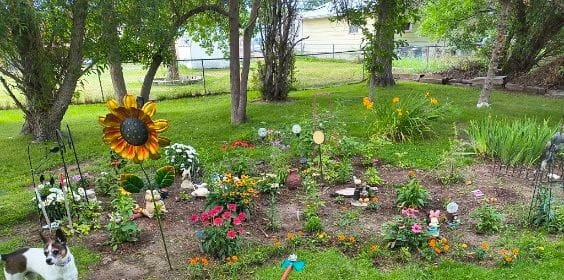
Today, Connie’s home is not only safe—it’s comfortable and, in her words, beautiful. The financial pressure that once felt overwhelming has eased, allowing her to focus on the things she enjoys most. She loves cross-stitching, playing word games on her phone, and spending time in her garden. Flowers are her favorite, and she takes pride in watching them grow, season after season.
Connie’s story is not just about a financial product. It’s about perseverance, community support, and the relief that comes when stability is restored. After decades of work, hardship, and determination, she’s able to remain in the home she loves—on her own terms.
And in a place where doors are still left unlocked, that peace of mind means everything.